Dr. Gymbro
←

#sodium bicarbonate

3 articles
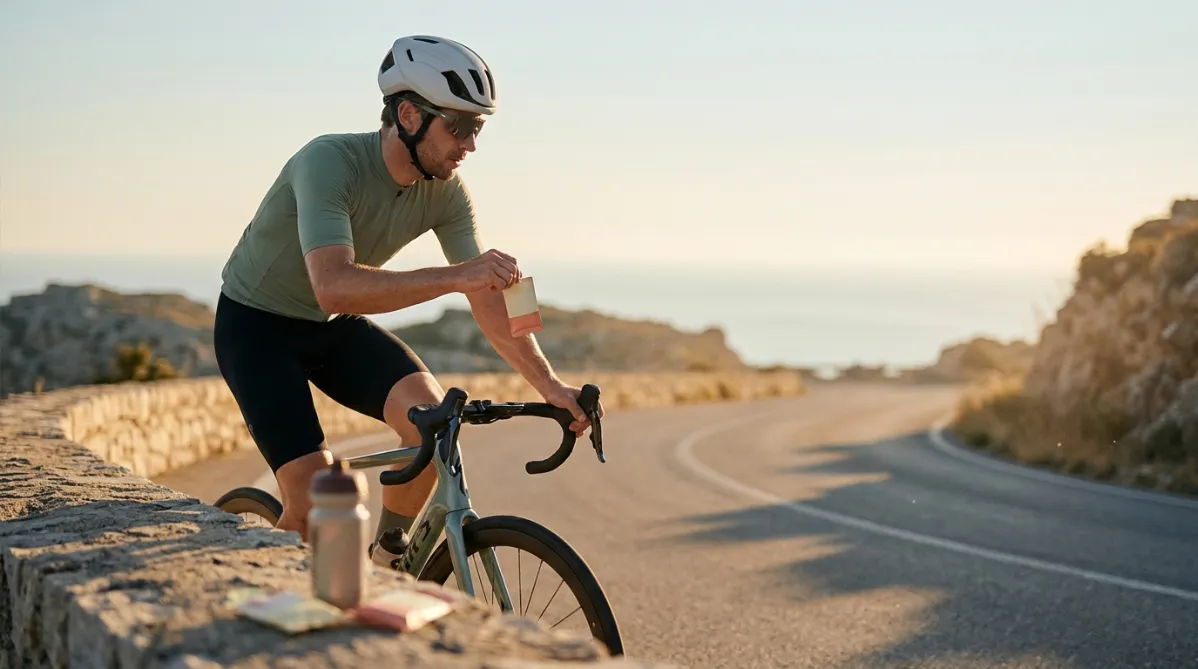
A cyclist in profile, riding a sleek road bike along a quiet coastal road in warm golden-hour light, shot from a low side angle with a shallow depth of field. The rider wears a muted sage-green jersey, black bib shorts, a matte white helmet, and sunglasses. Their face shows calm, focused fatigue, with a faint sheen of sweat on the forearms. One hand is lifted slightly from the handlebars, holding a small, unbranded matte gel packet in soft cream and coral tones, just before opening it. The road curves gently behind them toward a hazy, softly blurred horizon of pale sea and distant hills, with long amber shadows stretching across the asphalt.

In the foreground, slightly out of focus, a few gel sachets and a bike bottle rest on a weathered stone wall at the left edge of the frame, adding editorial depth. Fine dust and sunlight glow in the air. The palette is warm and restrained: butter yellow, soft peach, sage, and slate blue, with gentle film-like grain. The composition leaves open negative space in the upper right, a pale gradient sky, for headline overlay. The overall look is a modern, minimalist sports-science magazine photograph: natural, premium, and clean, with realistic textures, cinematic but understated color grading, and no text, logos, or graphics.
nutrition

Bicarbonat‑Gels während einer 3‑Stunden‑Fahrt steigern Leistung um 12 W

BY DR. GYMBRO ·

Was, wenn der optimale Zeitpunkt für die Einnahme von Natriumbicarbonat nicht vor dem Wettkampf, sondern währenddessen liegt? In einer randomisierten Crossover‑Studie mit 11 trainierten Radfahrern wurden Natriumbicarbonat‑Kohlenhydrat‑Gels über drei Stunden Fahrt getestet. Im erschöpften Zustand danach lag die 12‑Minuten‑Zeitfahrleistung um 12 W höher als bei reinen Kohlenhydraten, und gastrointestinale Beschwerden unterschieden sich nicht. Sprint‑ und 2‑Minuten‑Versuche zeigten jedoch keinen signifikanten Nutzen, die Stichprobengröße war klein und die Produkte stammten von MNSTRY.
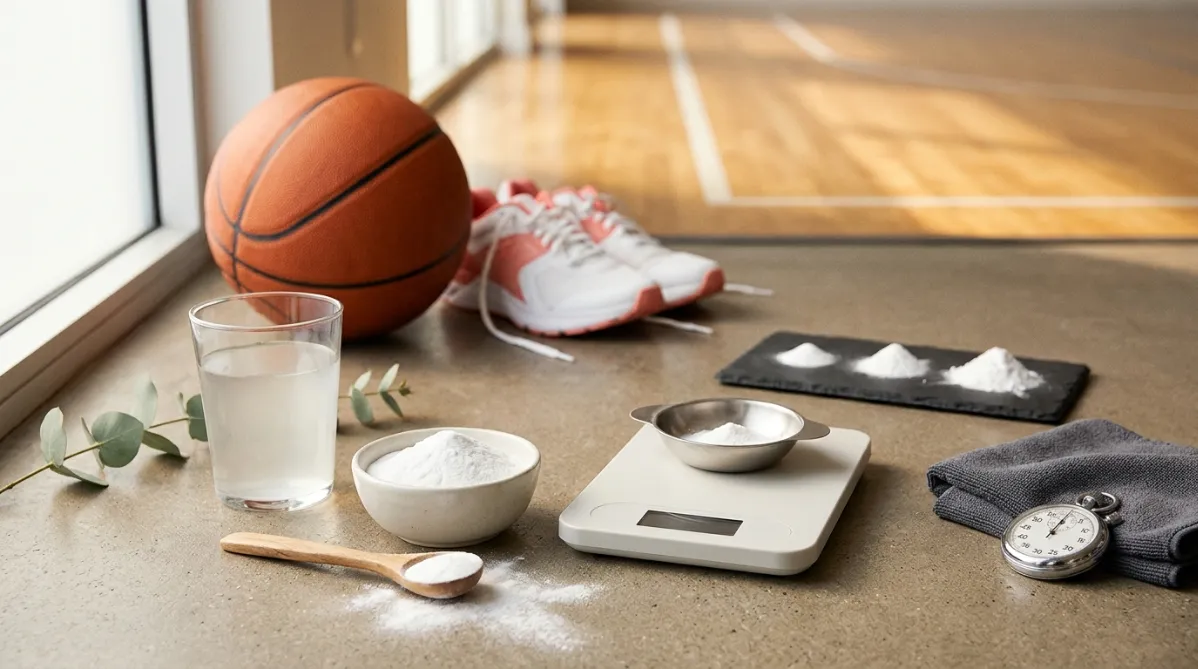
A wide, editorial-style still life shot from a slightly elevated angle on a pale, warm-gray concrete surface lit by soft natural window light from the left. In the center foreground, a clear glass of cloudy water sits beside a small white ceramic bowl heaping with fine white baking soda powder, a wooden measuring spoon resting beside it with a light dusting of powder spilling across the surface in a graceful arc. Next to them, a minimalist digital kitchen scale in matte white shows a small portion of powder in a shallow dish. Slightly behind, an orange basketball is partially in frame, its pebbled texture catching the light, resting beside a pair of clean white and coral athletic sneakers with the laces loosely undone. A folded charcoal gray towel and a stainless steel stopwatch lie to the right, the stopwatch face crisp and legible. Three small, neatly arranged piles of white powder on a slate tile in the midground, in ascending sizes, hint at different doses without any text or labels. In the soft-focus background, the faint outline of an indoor basketball court with warm honey-colored hardwood floor and blurred lane lines stretches across the frame, glowing with golden-hour light. The color palette is restrained and modern: warm off-white, soft gray, burnt orange, and touches of sage green from a single sprig of mint or eucalyptus laid near the glass. Shallow depth of field, crisp textures on powder grains and the ball's surface, gentle shadows, subtle film-like grain. Clean negative space in the upper right for headline overlay. The mood is calm, sleek, and contemporary, like a premium health and sports science magazine cover, with a fresh, minimalist composition and no people, no text, and no futuristic elements.
nutrition

Natron & Sprinttraining: Die Dosis, die das Placebo bei allen Tests übertraf

BY DR. GYMBRO ·

Eine neue randomisierte Studie mit Basketballspielern zeigte, dass Natriumbicarbonat (Natron) in Kombination mit vier Wochen Sprint‑Intervall‑Training das Placebo bei Sprung‑, Sprint‑, Agilitäts‑, Yo‑Yo‑ und Wingate‑Leistung übertraf. Die höhere Dosis von 0,45 g/kg war bei allen Messwerten überlegen gegenüber 0,3 g/kg. Natron ist damit ein günstiger Zusatz für Mannschaftssportler – das Magen‑Problem bleibt jedoch ein Stolperstein, und die Studie ist klein, kurz und nur mit Männern durchgeführt worden.
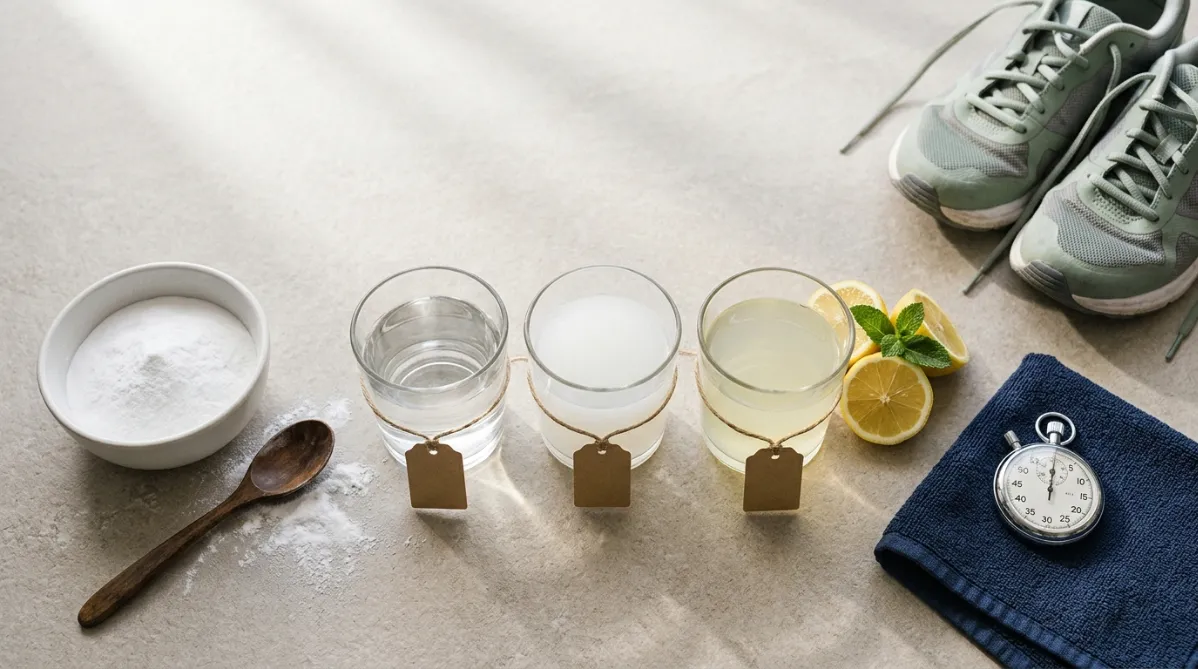
A wide, editorial-style flat lay photographed from above on a pale warm-gray stone countertop in soft morning window light. On the left, a simple white ceramic bowl holds fine white baking soda powder, with a vintage wooden spoon resting beside it and a light dusting of powder spilling across the surface. In the center, three identical clear glass tumblers sit in a neat row, each filled with a slightly different cloudy liquid: one almost clear, one milky white, one faintly yellow-tinged. Small kraft paper labels tied to the glasses with twine remain blank. To the right, a minimalist silver stopwatch lies on a folded navy athletic towel, its hands frozen mid-count. A few fresh lemon halves and a single sprig of mint add a bright, natural accent near the citrate glass. A pair of worn but clean women's running shoes sits partly in frame at the upper right corner, laces loose, hinting at an athlete without showing a person. Subtle long shadows fall diagonally across the scene, giving depth and a calm, modern feel. The color palette is muted and cohesive: chalky whites, soft sage green, warm sand, deep navy, and small pops of lemon yellow. Shallow depth of field gently blurs the edges, with crisp focus on the center glasses and stopwatch. Plenty of clean negative space across the top third leaves room for a headline overlay. The overall look is a trendy health and performance journal: clean, tactile, slightly grainy film-like texture, natural and understated, with no text, no logos, and no futuristic elements.
nutrition

Natron schlägt Natriumcitrat und die Kombination um 17 Sekunden

BY DR. GYMBRO ·

In einer Crossover‑Studie mit zehn hochtrainierten weiblichen CrossFit‑Athletinnen verkürzte Natriumbicarbonat die 6‑km‑Zeitfahrt um 21,5 Sekunden gegenüber Placebo, während Natriumcitrat und die Kombination keinen klaren Vorteil boten. Natriumbicarbonat war zudem 11,6 Sekunden schneller als Citrat und 17,2 Sekunden schneller als die Kombination – allerdings gingen damit vermehrte gastrointestinale Beschwerden einher. Hier erfährst du, was die Studie ergab, warum das Stapeln von Puffern nicht funktionierte und wie du das Vorgehen sicher testen kannst.

This page is available in